
Insights / Managers
How to run a six-session workshop series for first-time managers, online
A one-day workshop gives new managers a lot to hear and little to try. A series gives them a week between sessions to use one small move, then come back and say what happened. Here is how I would run it live, and the kit I built for it.
By McKinley Malbrough III, J.D., MS-HRM. Published November 4, 2026.
Short answer
Run six live sessions, one topic each: peer to manager, one-on-ones, feedback, delegating, hard conversations, and time and energy. In every session people talk, try the awkward version out loud in small practice rounds, and leave with one small move to make that week. Open the next session by asking what happened. The facilitator kit I made for this is the $49 First-Time Manager Workshop Series.
Built for this situation
Take it with you
Online Facilitation Skills gear
Made to order. Returns terms are on the Refunds page.See all gear
Why run a series instead of a one-day workshop for new managers?
A new manager does not need more information. They need to say a hard sentence out loud once before they have to say it to a real person, and then to find out what happened when they did. A single day can introduce the ideas. It cannot give anyone a week of real work to test them against.
A series fixes the gap. Each session ends with one small move to make before the next one, and each session opens with a report on that move. The report is where the learning happens, because it is about this person's team and this person's week, not a case study. That is my opinion from facilitating, not a measured result, and I would rather say so than borrow a statistic.
It also matches how the promotion happens. People become managers on a Monday and are expected to know how to run a one-on-one by Friday. Six shorter live sessions let them learn the job in the order the job arrives. If you are deciding between formats, first-time manager training covers the options, and virtual instructor-led training vs e-learning explains why live beats recorded for this kind of skill.

What are the six sessions, in what order?
The order follows what a new manager meets first. These are the six I use:
- Peer to manager. The change in the relationship with the people who used to be colleagues, and what to say on the first day
- One-on-ones. How to run a regular conversation that is about the other person, not a status report
- Feedback. Saying the useful thing, early, in plain words
- Delegating. Handing over work with a clear outcome, a date, and room to do it their way
- Hard conversations. Opening, staying steady, and closing with an agreed next step
- Time and energy. Protecting the manager's own week so the first five sessions can be used
Keep the order. Peer to manager comes first because it is the one new managers feel immediately and say least about. Hard conversations come fifth because by then the group has practiced enough to try them with each other. For the habit behind the fifth session, see difficult conversations training for managers.
How should each session run?
Use one shape for all six so the group learns the rhythm. Here is the 90 minute version, with the 60 minute version noted after it:
- 0:00 to 0:10 Open. Each person reports the small move they made since last time, in one or two sentences, or says what got in the way
- 0:10 to 0:25 Frame. One idea, one example, one sentence a manager could actually say
- 0:25 to 1:05 Practice. Triads take turns as manager, team member, and observer, using a scenario card, with a short debrief after each round
- 1:05 to 1:20 Whole-group debrief. What was hard, what worked, what to try differently
- 1:20 to 1:30 Commit. Each person writes one small move for the week and says it aloud
For the 60 minute path, shorten the frame to 10 minutes and run two practice rounds instead of three. Do not cut the opening report or the closing commitment. They are what turn six separate sessions into one program. Time it as you would any timed agenda.
How do you make practice safe enough to be useful?
The practice rounds are the point and also the risk. People will not try the awkward version out loud unless the cost of getting it wrong is close to zero. Three things lower the cost:
- Use fictional scenarios. Practicing on a made-up situation, not on a real team member, means nobody is rehearsing gossip and nobody has to disclose anything
- Fix the roles and rotate them. The observer's job is to notice one thing that worked and one thing to try, which keeps feedback specific and kind
- Keep the triads small and private. A group of three in a breakout room is a much smaller stage than the whole cohort on camera
Say aloud at the start that fumbling is expected and that nothing said in a practice round leaves the room. Then go first yourself with an imperfect attempt. More on running the rooms in how to run a breakout room and how to build psychological safety in a virtual meeting. The person who freezes in the middle of one is the subject of the manager who freezes.

How do you find out whether the series worked?
Be modest about it. A six-session series can record what happened. It cannot, on its own, prove a change in team results. Keep the evaluation to things you can actually observe:
- Who attended each session, so you can see where people drop off
- What people committed to each week, and what they reported the next week
- Feedback at the end of each session in two or three short questions
- A facilitator debrief after every session: what to change before the next one
Then ask the manager's own manager, a month later, what they have noticed. That is a conversation, not a metric, and it is more honest than a score. For the longer argument, read how to measure training and finance wants one decision, not training metrics.
What is in the facilitator kit, and what is it not?
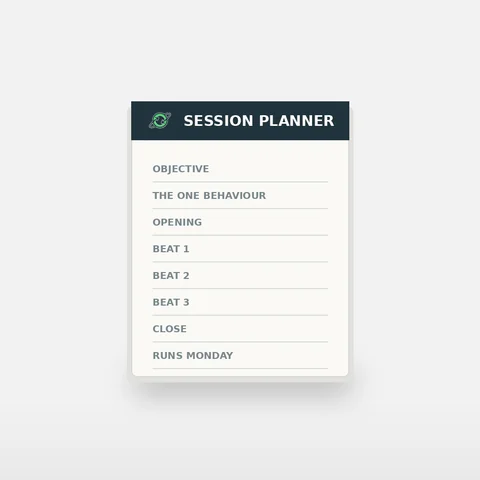
I built First-Time Manager Workshop Series: 6-Session Facilitator Kit ($49) so a trainer or an HR lead does not have to build the six sessions from scratch. As described on the product page, you get:
- A facilitator guide of 40 pages with minute-by-minute run sheets for the 90 minute and 60 minute paths, word-for-word scripts, breakout prompts, and debrief questions
- A participant workbook of 26 pages with pre-work, worksheets, commitment pages, and a 90-day plan
- A slide deck of 79 slides with the script in the speaker notes
- 18 fictional scenario cards for the practice triads, three per session
- 12 pre-work and follow-up emails in a copy-and-paste text file
- An Excel evaluation sheet with seven tabs for the roster, feedback, summary, commitments, and facilitator debrief
What it is not matters as much. It is not California harassment prevention training. Supervisors at employers with five or more employees have a separate legal duty, and this series does not satisfy it. The requirements are laid out in California harassment prevention training requirements. It is also not legal advice, it promises no change in manager behavior, and it is not a recorded course. You run it live.
Give new managers a week to try it
The strongest thing a manager series does is give people something to report on. A small move, a week, an honest report, and a room that has practiced hearing it. You can build that yourself with the outline above, or start from the $49 kit if you would rather spend your time facilitating than formatting.
If you want to see how this kind of practice-based live session is run, and get feedback on your own facilitation, the next step is the events page. Book a course and choose the session that fits.
Keep going
First-time manager training
The options, and what each is good for.
Difficult conversations training
The fifth session, in more depth.
Book a course
Live sessions with dates, seats, and prices published.