
Field notes / Business
The Price You Quote Is the Scope You Agree To
A day rate said out loud on the first call is a promise about work nobody has described yet.
By McKinley Malbrough III, J.D., MS-HRM. Published October 22, 2026.
Short answer
Facilitators quote a day rate and then absorb the preparation, the pre-calls and the rewrite. The fix is a written scope before the number is said. The number then becomes the sum of lines the client has read, and every change after that is a priced change instead of a favor.
Built for this situation
Take it with you
Online Facilitation Skills gear
Made to order. Returns terms are on the Refunds page.See all gear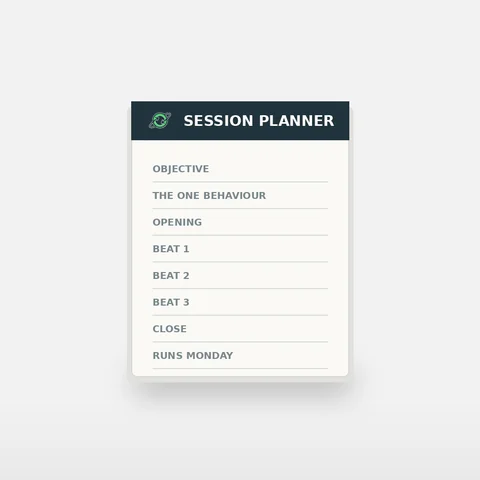


The number comes first
A buyer asks what you charge. You say a number, usually a day rate, because that is the unit the question invites. It sounds like an answer. It is the start of a negotiation about work neither of you has described. The client hears the price of a workshop. You meant the price of a day. You are now holding different objects and neither of you knows it.
I think this is the most common pricing mistake in facilitation, and it has little to do with whether the rate is high enough. A fair rate attached to an unstated scope loses money as reliably as a low rate does.
The fix is not a higher rate or a tougher stance in negotiation. It is sequence. Say what the work is, in writing, and let the number be the total of lines the client has already read.
Where the hours go
After a day rate is said, unpaid work enters in three places:
- The pre-call that becomes three calls, because nobody wrote down who needed to be on the first one
- The preparation that grows to fit client material that arrives late and in a different format than described
- The rewrite, when a sponsor reads the draft agenda and wants a different session
Here is a hypothetical, using the illustrative $2,000 day rate from how to price a workshop. A client asks for a four-hour workshop and hears $1,000, which is half a day. The formula counts 0.5 day of delivery and 0.75 day of preparation, so the fee should have been $2,500. Add two more calls and a rewrite, and the work looks like this:
| Line | Days |
|---|---|
| Delivery | 0.5 |
| Preparation | 0.75 |
| Two extra calls | 0.25 |
| Rewrite | 0.25 |
| Total | 1.75 |
At $1,000 for 1.75 days, the facilitator earned about $571 a day, under 30 percent of the stated rate. Nobody was dishonest in that story. The number just arrived before the scope did.

Preparation is not overhead
The client sees four hours in the room, so the client prices four hours. Everything that made those hours work sits out of sight: the sponsor call, the design, scenarios rebuilt from the client’s own description, the platform check. If your number follows the hours in the room, you teach the buyer to price the visible tenth of the job.
The published planning ratios are not small. The UNC School of Government’s public leadership center builds one day of preparation into each day of facilitation, and Ruzuku’s pricing guide suggests 1.5 days for a turnkey workshop and 3 for a bespoke one. A scope turns that invisible time into lines the client can read, and a line can be priced.
Why we say the number first
The question is phrased as a number, so the answer is one. Asking what is included feels like stalling, and a quick answer feels like confidence. A day rate is also easy to say and hard to argue with, which makes it comfortable for both sides.
Buyers do not mean harm by it. They have a budget line, and the first number they hear is the one they write on it. A number without a scope is a guess the buyer will hold you to.
Scope first, number second
The order I recommend is short:
- Say the outcome back in one sentence, and get a yes
- List the days: design, preparation, delivery and follow-up
- Write what is not included
- State the headcount you are assuming and the rate for each person added
- Add up the lines
Step three does the most work. A list of exclusions tells the client you thought about the job, and it is where the limit on calls, the limit on revisions and the boundary on follow-up live. Clients rarely object to an exclusion they read before signing. They object to the one they discover afterward.
The number is now a sum the client has read. What belongs in that scope, including a hypothetical scope table and the cancellation and ownership terms I would not leave out, is in what goes in a facilitation proposal and scope of work.
When the buyer wants a number first
Some buyers need one: a procurement form, a budget deadline, a manager who needs a figure by Friday. You can still keep the scope attached. Give a range inside a sentence that states the scope.
A hypothetical script: “For a half-day live online workshop for about 20 people, one session and one round of changes to the materials, the fee is $2,500 to $3,000. I will send a one-page scope this week so you can see what is in it.”
If the buyer insists on a bare number, give it and write the assumptions directly under it. A number with its assumptions attached can be revised when the assumptions change. A bare number cannot.
Headcount is part of the scope
A second hypothetical. You quote a session for 20 people and the client sends 35. Nothing in a bare day rate says the fee should change, yet the work did: more breakout rooms to manage, more materials, more to follow up. If you absorb it once, the next client learns that the number was never tied to the room.
So I write the planned headcount into the scope as an assumption and name a per-person rate for anyone added. A headcount change then becomes a priced change, confirmed in writing, instead of a disagreement after the session.
What changes when the scope is written
Pushback turns into a conversation about scope. Instead of cutting the rate, you remove a deliverable, a session or a round of changes, and the buyer sees what each cut costs them. Scope creep becomes a priced change instead of a favor you resent. The sponsor can forward one page to finance, and finance can read the lines.
The objection I hear most is that a written scope feels like bureaucracy for a small job. The job is small, so the page is small. One page with seven lines takes less time than a single extra call, and it is the only document that can settle an argument later.
It costs something. The scope takes an hour to write, and now and then a buyer walks away from it. I would rather lose that buyer at the scope than keep them through an invoice dispute over the extra days. If you are the buyer, ask for exactly this. The questions are in what a corporate facilitator costs.
What I would do first
Take your last quote and list every hour you worked on it that the quote does not mention. That list is the scope you did not write. Put it in the next one, price it with the formula in how to price a workshop, and say the number last.
Keep going
How to price a workshop
The formula, with worked examples.
Facilitation proposal and scope of work
What goes in the written offer.
What a corporate facilitator costs
The buyer side of the same numbers.
Workshop pricing calculator
Run the formula with your own numbers.
Want a second read on a quote?
Bring a quote you sent. In a free consult we mark the hours it does not mention and turn them into a one-page scope.