
Insights / Learning and development
How do you build an upskilling and reskilling plan for a small team?
You can see that roles are changing and still not know what to teach first. A five-step plan gets you from a blank page to a 90-day calendar of short live sessions, with one page that shows whether anything changed.
By McKinley Malbrough III, J.D., MS-HRM. Published November 6, 2026.
Short answer
Build the plan in five steps: map the skills each role needs now, rate where each person stands, rank the gaps by business impact, schedule the top gaps as short live sessions across 90 days, and measure change on one page. Hire instead of train when the gap is too large to close inside the time the work allows.
Built for this situation
Take it with you
Online Facilitation Skills gear
Made to order. Returns terms are on the Refunds page.See all gear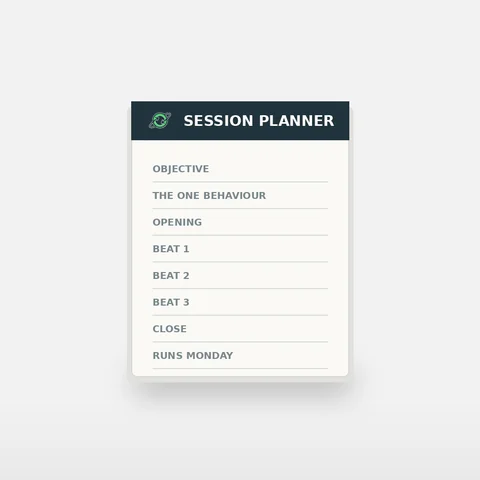
What is the difference between upskilling and reskilling, and which does a small team need?
Upskilling teaches people new skills for the job they already do. Reskilling prepares them for a different job. Most small teams need upskilling first, because the work they do is changing faster than the job titles. Reskilling comes in when a role is disappearing or a new one is needed and you want to build from inside.
The distinction changes the plan. Upskilling works best as short, frequent sessions close to the work. Reskilling needs a longer path with practice and a sponsor. For the full comparison, read upskilling vs reskilling. This page gives you the plan that works for either, sized for a team too small to have a learning department.

Step 1: How do you build a skills map?
List the five to eight skills each role needs to do its work well over the next year. Keep each one to a verb and an object, such as “write a clear client update” or “run a handoff meeting.” Pull them from three places: the actual work, what customers or clients ask for, and what is changing, such as new tools or new rules.
- Ask each person to list the three tasks that take the most skill and the three that take the most time
- Ask managers what they fix or redo most often on someone else's work
- Mark which skills are changing because of new tools, including AI, and which are stable
Put the result in one table with roles down the side and skills across the top. A small team can finish this in a single working session. If you want a structure for the session itself, use the session planner.
Step 2: How do you find the gaps without a testing program?
Rate each person on each skill from 0 to 3: cannot do it, can do it with help, can do it alone, can teach it. Use two raters when you can, the person and their manager, and talk through any rating where they differ by two or more. A conversation about the evidence is better than a quiz.
Then total the gaps. A skill where most of the team sits at 0 or 1 and the role needs 2 or 3 is a gap. A skill where one person sits at 3 is a resource: that person can teach it. Gaps that someone on the team has already closed can be taught from inside the team, which also builds the habit of learning from each other. AI upskilling is a facilitation problem explains why peer teaching works for tool change.
Step 3: How do you rank the gaps and decide what to teach first?
Score each gap on three questions, each from 1 to 3: how much does the work depend on it, how many people does it affect, and how soon does it matter. Multiply or add the three scores and sort. Teach the top three or four first.
- Dependence: would a client, a deadline or a risk suffer if this skill is missing
- Reach: does the gap sit with one person or the whole team
- Urgency: does a tool change, a launch or a rule change make it matter this quarter
This is how you answer “what do we teach first?” without a debate. The ranked list is the argument. If two gaps tie, choose the one a team member can teach, because it is cheaper and faster to start.
Step 4: What does a 90-day session calendar look like?
Turn the top gaps into short live sessions, not a long course. A pattern that suits a small team is one 45-minute live session every two weeks, one practice task between sessions, and one review at the end:
- Weeks 1 and 2: a kickoff session that shares the skills map and the ranked gaps, then session one on the top gap
- Weeks 3 to 8: three more sessions, one per gap, each ending with a task the team does in real work before the next session
- Weeks 9 to 12: a practice session where people use two or three skills together, then a review session that looks at the one-page measure
Each session needs a clear outcome, a short explanation, practice and a close with a commitment. The timed agenda for a virtual workshop gives the structure. Keep them live, because practice with feedback is what turns information into a changed habit.

Step 5: What goes on the one-page measure of change?
One page, filled in at the start and again at day 90. Keep it to measures you can see without a survey platform:
- The skill ratings from step 2, re-rated, with the number of people who moved up a level
- One piece of work product per gap, compared before and after, such as a client update or a handoff note
- One business measure that the skill should affect, such as rework, turnaround or a client comment
- Two sentences from the team on what they now do differently
Be honest about what the page can show. It shows change in skill and behavior. It does not prove that training caused a business result, since other things move too. For a method that keeps the claim fair, see how to measure training.
When should you hire instead of train?
Hire when the gap is too large for the time the work allows, or when the skill takes years to build and you need it now. Three tests help:
- Time to competence: if getting someone to a usable level takes longer than the work can wait, hire or contract
- Depth of need: if you need an expert and not a capable practitioner, hire the expert and let them teach the team
- Fit with strengths: if no one on the team has the base skills to build on, training will be slow and frustrating
Often the right answer is both: hire or contract for the deep skill and train the team to work with it. Teaching beats telling when the people already know the work, and hiring beats teaching when the clock matters more than the learning.
Start with the map, finish with the calendar
A small team does not need a learning department. It needs a skills map, a ranked list of gaps, a 90-day calendar of live sessions and a page that shows what moved. Do those five steps and you will know what to teach first and whether it worked.
If you want a facilitator to run the sessions on your calendar, or to learn to run them yourself, the next step is the events page. Book a course and choose the session that fits.
Keep going
Upskilling vs reskilling
Which one you need and how they differ.
How to measure training
Show change without overclaiming.
AI upskilling is a facilitation problem
Why peer teaching works for tool change.