
How can a facilitator get better every session by changing only one thing?
Most facilitators do one of two things after a session. They run the same design again, or they rebuild all of it after one bad comment. Neither tells you what worked. Kaizen, the practice of steady small improvement, gives you a third way.
By McKinley Malbrough III, J.D., MS-HRM. Published November 13, 2026.
Short answer
A facilitator improves fastest by changing one thing per session and checking one signal. Use five steps: notice a friction, pick one change, run it, check the signal you chose in advance, then keep or drop the change. Seven small changes are worth testing first, including a two minute check-in, a 60 second silent writing round and a written commitment. Record each change in a log so the next session starts from what you learned.
Built for this situation
Take it with you
Online Facilitation Skills gear
Made to order. Returns terms are on the Refunds page.See all gear

What client problem does this solve, and which tool fixes it?
The client problem. A company runs the same training every quarter. Feedback stays at “good session” and nobody can say what changed since the last one. When budget tightens, a program with no visible improvement is the first to be questioned.
How this article fixes it. It gives you a five step loop, seven small changes to test and a way to check each one, so every run of a session is better than the last and you can show why.
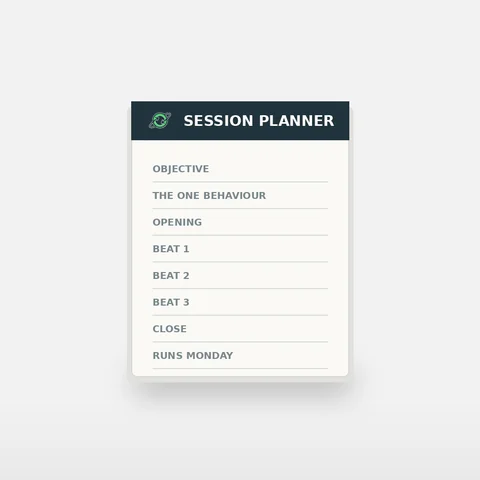
The tools. The free Live Session Design Canvas and Run-of-Show ($0+) holds the one change you are testing on the same page as the agenda. The Training Evaluation Kit: Learning, Not Completion ($29) gives you the signals to check. If you want a session improved with you, Book a free consult.


What does kaizen mean, and why does it fit facilitation?
Kaizen is a Japanese word most simply rendered as “change for the better.” Mark Graban, writing on the Lean Blog in 2026, stresses that a change only counts as kaizen when it makes something better in a way you can see, and that the people who do the work make the changes. He quotes Masaaki Imai: “Kaizen is everybody’s business.”
It sits close to the Plan-Do-Check-Act cycle that the American Society for Quality describes: design a change, test it on a small scale, review what you learned, then expand it or try something else. ASQ says the cycle has no end and belongs in everyday work.
Facilitators already have the raw material. You run similar sessions again and again, you watch participants closely and you can change one element without rebuilding the program. That is a small, repeatable test, and most of us never treat it as one.
What is the one-change loop?
Five steps, run once per session. Keep each to a few minutes.
- Notice. In the debrief, name one friction. Example: the first ten minutes felt flat.
- Pick one. Choose one change aimed at that friction, not three. Write it in one line.
- Run it. Make the change in the next session and leave everything else alone.
- Check. Look at one signal you chose before the session, such as how many people spoke in the first ten minutes.
- Keep or drop. Keep the change, drop it or adjust it. Write the result in your log.
The rule that makes it work is one change at a time. If you change four things and the session improves, you will not know which one did it.
Which small changes are worth testing first?
These are my own suggestions, picked because each is cheap and each aims at a common friction. Pick the one nearest your current problem.
- 2 minute check-in. Open with one question everyone answers in the chat, so the first voice is not yours.
- One slide cut. Remove the slide you most often rush past.
- 60 second silent writing. Ask people to write an answer before anyone speaks, so quiet people are not talked over.
- One real case. Replace an invented example with a case from the group’s own work.
- One named decision. State at the start what the group will decide by the end.
- 5 minute breakout. Move one discussion from the full group into pairs.
- One line commitment. End by having each person write one action, a date and who will see it.
How do you tell whether a change worked?
Choose the signal before the session, not after. Otherwise you will find a reason to like whatever happened. Good signals are simple to count: how many different people spoke in the first ten minutes, how many wrote a commitment, how many questions came in the chat.
Match the signal to the level you want to move. Kirkpatrick Partners describe four levels of training evaluation: reaction, learning, behavior and results. A check-in changes reaction and participation. A real case and a written commitment can move learning and behavior. Do not claim a result at a higher level than the one you measured.
One session proves little. Treat the first run as a signal and the second run as a confirmation. If you want the full measurement approach, the Training Evaluation Kit: Learning, Not Completion ($29) is built for it, and how to measure whether training worked explains the thinking.


How do you involve participants and co-facilitators?
Kaizen belongs to the people doing the work, so make the loop visible. Tell the group, in one sentence, what you are trying: “Today I am testing a short silent writing round, and I will ask you how it went.” People are usually generous and specific when they know you are experimenting.
End with two questions in the chat: what helped you most, and what one thing would you change? With a co-facilitator, hold a ten minute debrief the same day and fill the log together. The log needs only four columns: the change, the signal, what happened and keep or drop.
Over a quarter, the log becomes your own evidence base. It also makes a stronger case to a client than a list of testimonials, because it shows how the session improved and why.
When is a small change not enough?
Kaizen has limits. If the learning objective is wrong, small changes polish the wrong session. If the audience is not the audience the program was built for, rebuild the design. If the content is fixed by law or policy, change delivery, not content, and keep the required material intact.
A useful test: if the same friction survives three different small changes, the problem is upstream. Go back to the objective. How to write learning objectives shows how, and the The Facilitator's Field Guide ($19) covers the full session design cycle.
Change one thing in your next session
You do not need a new program. You need one friction named, one change made and one signal checked, then the same again next time. Start with the 60 second silent writing round or the written commitment, and record what happens.
To have a session improved with you, Book a free consult or book a course.
Where these facts come from
The meaning of kaizen, the point that the people doing the work make the changes and the Imai quotation come from Mark Graban, “Kaizen: The Improvement System Most Organizations Talk About but Struggle to Practice,” Lean Blog, March 10, 2026, at leanblog.org. The four steps of Plan-Do-Check-Act and the point that the cycle repeats come from the American Society for Quality, PDCA Cycle. The four evaluation levels come from Kirkpatrick Partners. The five step loop, the seven small changes and the log are my own practice, offered as opinion, not research findings. I confirmed the sources on November 13, 2026.
Keep going
More on session design
- You have the HR templates. Why are they still unused, and how do you facilitate them?
- Which ten learning and development models are worth knowing, and how do you teach each one live?
- How to run a virtual annual planning session that produces decisions, not just notes
- How do you cut lecture time in a 60-minute virtual session?
Why training does not stick
Seven habits to fix.
How to measure whether training worked
Evidence beyond completion.
How to write learning objectives
Aim the change correctly.